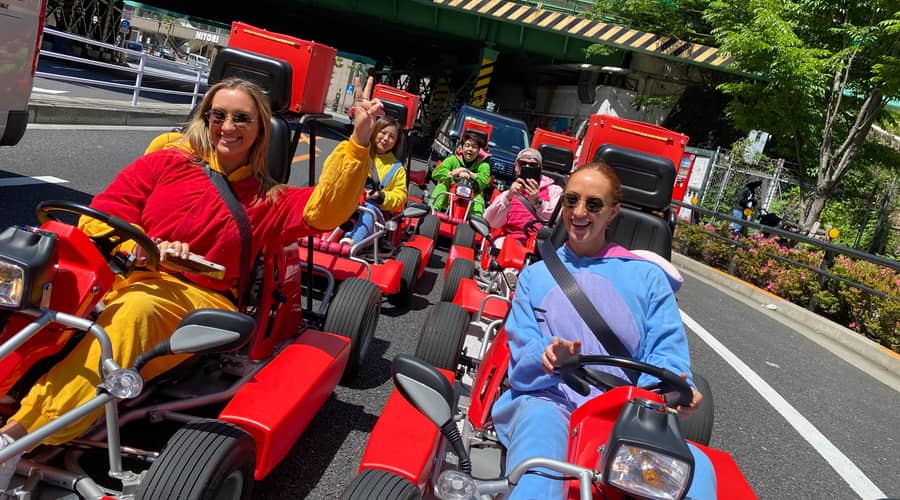
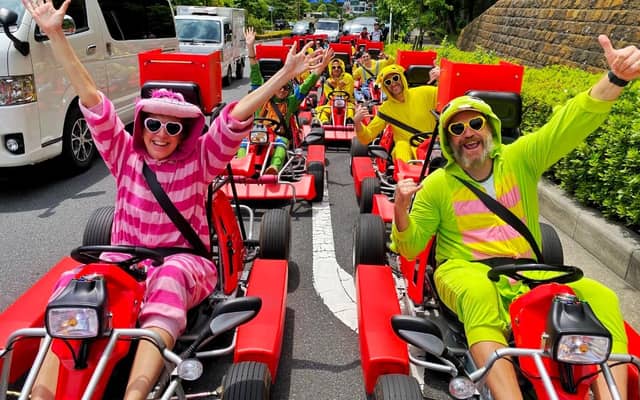
How to Go Kart in Tokyo, Step by Step
Going karting in Tokyo takes five steps, and the first two happen at home. Eleven listings spell out the rule behind them: an invalid or missing document means no drive and no refund.
- 1Check your license country. A 1949 Geneva country needs an IDP; Switzerland, Germany, France, Belgium, Monaco and Taiwan need a JAF translation instead.
- 2Get the IDP at home from your official issuer — listings name AAA, AA, CAA and ATCUAE — never from an online company.
- 3Book the tour and note its cancellation rule: 7 days before on three of the four Street Kart listings, 24 hours before on most others.
- 4Arrive early. Listings ask for 20, 30 or 40 minutes before the start for check-in and the safety briefing.
- 5Show the three originals — license, passport, IDP or translation — then pick a costume and drive.
Step two is where most trips go wrong. Two listings (559629, 738795) say “Do not buy from online companies”, and four reject permits issued by IDA or IAA along with the 1968 Vienna card. Step four matters too: the Shinjuku listing (928764) builds a 15-minute safety briefing into its one-hour itinerary.
Documents sorted? Compare all 25 tours by zone, length and real price.
See all toursTokyo Go Kart License by Country — The Special Cases
Most drivers need either an IDP or a JAF translation, but the operators' “know before you go” notes, checked on 29 September 2026, name six special cases.
Even the right booklet must be complete: the Shinjuku operator (928764) asks you to check the IDP for missing information as soon as you receive it. On the East Tokyo tour, Carol (October 2025) saw two people turned away for missing documents.
Tokyo Go Kart License: The Three Originals You Show at the Counter
Every street go-kart tour in Tokyo checks the same three documents before you get a kart, and all three must be originals: your home driving license, your passport, and an International Driving Permit issued under the 1949 Geneva Convention. Several listings put it in almost the same words — "IDP issued in the booklet format compliant to the 1949 Geneva Convention" — and the wording matters, because there are two kinds of IDP in the world and only one works in Japan.
The 1949 permit is a gray paper booklet, roughly passport-sized, with a stamp and a photo. The 1968 Vienna Convention permit is usually a plastic card; Japan is not a party to that convention, so the card is refused at the door even if it is perfectly valid at home. Countries that issue the 1968 card by default include Germany, Switzerland, France, Belgium and Monaco, which is exactly why those countries — plus Taiwan — use a different route: an official Japanese translation of the home license from the Japan Automobile Federation (JAF), ¥6,000, two to three working days, instead of any IDP.1
An IDP can only be issued by the country that issued your license, and it cannot be obtained online or after you have already landed in Japan. In the United States that means AAA or AATA, in person or by mail, for about USD 20. In the United Kingdom it is a PayPoint shop (£5.50, issued on the spot); in Australia your state motoring club; in Canada a CAA store (CAD 32). Allow a week if you post the application. One operator adds a detail worth repeating: bring the book-type IDP, "card-type IDPs are not valid".
The counter check is not a formality. Eleven listings say in writing that a driver who arrives without one of the three originals does not drive and does not get a refund; the others simply won’t hand over a kart. Photocopies, phone photos and digital wallets are refused; so is a license that is valid at home but has expired.
A valid IDP lets you drive in Japan for up to one year from the date you entered the country. For a tourist that is never the limit; what catches people is the other direction — permits are dated from issue, usually for one year, so an IDP bought for a trip eighteen months ago is expired.
- Book-type IDP
- The 1949 Geneva Convention permit: a gray paper booklet with a stamp and your photo. The only IDP format accepted for driving in Japan.
Under 18, no kart on the street: every street tour needs a full driving license plus the permit, and most listings name 18 as the minimum age. The only under-18 option in the catalogue is the closed circuit outside Tokyo, from age 6, with its own junior kart. Passengers are not sold on any street tour on GetYourGuide as of 29 September 2026, so a licensed parent cannot take a child along.
Check dates for the tour you have in mind, then pick your country below to see exactly which three things go in your bag.
Check your licenseTokyo Go Kart IDP: 1949 Booklet, Not the 1968 Card
Japan recognizes only International Driving Permits issued under the 1949 Geneva Convention. The 1968 Vienna Convention card — often plastic, often the default in continental Europe — is refused at every counter, even when it is valid at home.
- 1968 card
- The Vienna Convention permit. Not accepted in Japan, which is not a party to that convention.
Check the cover before you fly: it should name the 1949 Geneva Convention, and it should be a booklet with your photo and a stamp. If it is a card, it will not work for a kart.3
International Driving Permit Tokyo Go Kart: Country by Country
Source: JAF, the issuing clubs and tour listings on GetYourGuide · checked Sep 2026
Do You Need a License to Go Kart in Tokyo — And What If You Don’t Have One
On the street, yes: a full home license, plus the permit or translation and your passport. Without a license the only option in the catalogue is the closed circuit outside Tokyo — from age 6 on a junior kart (¥40,000 per group), or ¥26,400 per group on the adult kart from 13. There are no passenger seats on any street tour, so a licensed adult can’t take a child or a friend along.
What Happens at the Counter
- 1Staff check the three originals before anything else.
- 2They read the expiry date on the license.
- 3Only then: costume, goggles, briefing.
- 4Missing one document: no drive, no refund.